

Views: 0 Author: Site Editor Publish Time: 2026-08-12 Origin: Site


Sizing a flash pasteurizer goes far beyond simply matching a basic pump flow rate. It requires a critical balance between ensuring microbiological safety, preserving delicate product flavors, and optimizing overall facility throughput. You must harmonize fluid thermal dynamics with continuous production demands.
An undersized unit creates immediate downstream bottlenecks. It starves your fillers and halts production lines. Conversely, oversizing causes excessive capital expenditure and spikes your daily utility demands. It also exposes your liquid to potential product degradation caused by frequent, unplanned recirculation cycles.
This guide provides a step-by-step framework to calculate the exact capacity, thermal requirements, and integration specifications you need. We will help you thoroughly evaluate and select the ideal commercial thermal processing system. You will walk away prepared to synchronize your entire operation successfully.
You must size your equipment based on continuous packaging demand. Avoid sizing based solely on daily batch yield. We break this process down into three specific calculations.
First, determine your target Liters Per Hour (LPH) or Gallons Per Minute (GPM). Base this metric purely on your packaging line speeds. If your canning line consumes 60 barrels an hour, your continuous thermal processor must supply exactly that amount. You must add a 10% to 15% capacity buffer. This buffer prevents the filler from constantly waiting for product. It eliminates system idling. You must also factor in operational changeover times. Your daily schedule includes start-up, shutdown, and Clean-In-Place (CIP) cycles. The equipment does not produce saleable liquid during these phases.
The holding tube determines your exact pasteurization time. We calculate holding time by dividing the tube volume by the volumetric flow rate. Most beverage applications target a 15 to 30-second hold. Flow velocity plays a crucial role here. You must maintain turbulent flow inside the pipe. Engineers measure this using the Reynolds number. Turbulent flow prevents laminar layering. It ensures the liquid at the center of the pipe reaches the same temperature as the liquid touching the pipe wall. Viscosity and particulate size dictate the required pipe diameter.
You need adequate utilities to heat and cool the liquid. Steam or hot water provides the heating utility. Glycol or chilled water provides the cooling utility. We calculate these loads using the specific heat capacity of your exact product. A high-quality Flash Pasteurizer utilizes a heat regeneration section. The hot, exiting liquid transfers its thermal energy to the cold, incoming liquid. You should evaluate this regeneration efficiency closely. Industry standards range from 85% to 95%. Higher regeneration means you rely less on your facility boiler and chiller. It dramatically lowers your monthly energy bills.
Different liquids demand entirely different thermal profiles. You cannot use a generic sizing approach.
Brewers focus heavily on strict Pasteurization Unit (PU) control. A single PU represents one minute of holding time at 60°C. Precise PU management prevents flavor oxidation. It stops thermal degradation and preserves aromatic hop compounds. Carbonation presents a unique physical challenge. Heated liquid loses its ability to hold CO2 in solution. You must install high-pressure booster pumps. These pumps elevate system pressure above the saturation point. They keep the CO2 locked inside the liquid during the high-temperature heating phase.
Dairy products introduce entirely different biological threats. Milk and cream demand aggressive pathogen destruction. Sizing for dairy processing equipment follows strict High Temperature Short Time (HTST) guidelines. Regulatory bodies mandate minimum temperatures and times, typically 72°C for 15 seconds. Dairy liquids also contain high fat and protein levels. These components scorch easily under high heat. You must factor product viscosity into your plate selection. Thicker liquids require wide-gap plate corrugation patterns. Proper plate spacing reduces shear stress. It prevents protein fouling and burn-on within the heat exchanger.
Standard flash pasteurization targets a refrigerated shelf life. Sometimes you need an ambient, extended shelf life. You must consider an upgrade to Ultra-High Temperature processing. A UHT sterilizer pushes liquids past 135°C for just two to five seconds. It destroys all bacterial spores.
Table 1: Processing Parameters Comparison
| Parameter | Beer / Cider (Flash) | Milk (HTST) | Dairy / Alt-Milk (UHT) |
|---|---|---|---|
| Target Temperature | 71°C - 74°C | 72°C - 75°C | 135°C - 145°C |
| Holding Time | 15 - 30 seconds | 15 - 20 seconds | 2 - 5 seconds |
| Shelf Life Goal | Extended Refrigerated | Standard Refrigerated | Ambient (Months) |
Be aware of the significant jump in facility requirements. UHT systems require a much larger footprint. They demand specialized high-pressure homogenizers and massive utility inputs compared to standard HTST systems.
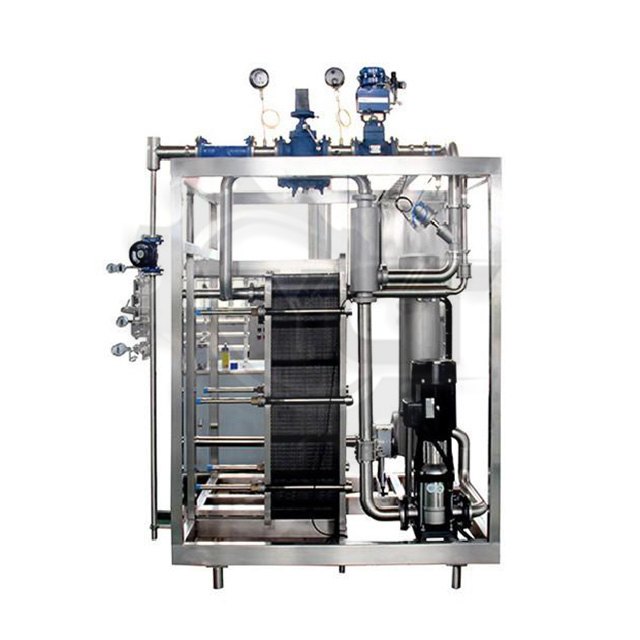
You must evaluate if a flash system truly fits your production model. Alternative processing methods offer different operational advantages and drawbacks.
Tunnel systems are massive machines. They process the liquid inside the final sealed container. They spray zones of hot and cold water over cans or bottles moving on a conveyor.
Sterile filtration removes bacteria mechanically. It forces liquid through tight, microscopic membrane filters instead of using heat.
Chart: Suitability Matrix for Processing Alternatives
| Method | Best For | Main Drawback |
|---|---|---|
| Flash System | Clear & pulpy liquids, high volumes | Requires highly aseptic filling downstream |
| Tunnel System | Bottled/canned goods, lower hygiene fillers | Massive facility footprint, high flavor impact |
| Sterile Filtration | Small batches, ultra-clear liquids | Extremely high consumable filter expenses |
Standalone sizing creates massive integration risks. You cannot buy a thermal unit without looking downstream at your packaging equipment.
Packaging lines rarely run perfectly continuously. Fillers experience frequent micro-stops due to jammed cans or lid faults. When the filler stops, the thermal processor cannot simply turn off. The system diverts the product flow back to the balance tank. It sends hot liquid back through the loop. We call this the recirculation trap. Prolonged recirculation bakes the product. It adds excessive PUs and ruins the flavor profile. It also dumps massive heat loads into your cooling system, wasting expensive utility energy.
You must decouple the continuous thermal process from the variable packaging process. An aseptic buffer tank acts as a necessary shock absorber. It holds the processed, sterile liquid safely while the filler pauses. Sizing this tank correctly is critical. We recommend specific standard ratio guidelines. Your buffer tank volume should equal 20 to 30 minutes of your pasteurizer flow rate. If your system runs at 60 barrels per hour, you need a 20 to 30-barrel buffer tank. This provides operators enough time to fix filler jams without triggering a recirculation cycle.
Your new equipment relies entirely on your facility's utility backbone. Verify your existing boiler capacity early. Check your available chiller loads. A perfectly sized unit will fail immediately if the facility cannot supply consistent utilities. Dropping steam pressure causes the heating temperature to plummet. Unstable glycol temperatures prevent the liquid from cooling down before packaging. You must audit your utility headers during the initial sizing phase.
Modern thermal processing requires strict precision. You cannot rely on manual valves. Hardware alone does not guarantee a safe, compliant product.
You need robust PLC-based PID controllers. These controllers manage automated temperature adjustments in real-time. They react to thermal fluctuations in milliseconds. Food safety compliance demands comprehensive documentation. FDA and FSMA guidelines require tamper-proof digital charting. You must prove every drop of liquid reached the critical temperature. Automated flow-diversion valves are equally important. If the temperature drops one degree below the setpoint, the valve triggers instantly. It redirects the unsafe liquid away from the filler.
Production demands grow over time. You should not lock your facility into a rigid capacity limit. Advise your purchasing team to look for modular equipment frames. Specify a plate heat exchanger frame that can accommodate 20% to 30% more plates. This smart design choice allows for future capacity expansion. You can increase your production volume later without buying an entirely new skid.
Do not accept generic marketing claims. Look closely at the engineering spec sheet. Demand specific performance guarantees from your chosen vendor. Require rigid temperature delta tolerances. Ask for guaranteed PU accuracy metrics across different flow rates. You should also evaluate their guaranteed CIP recovery times. A fast CIP turnaround increases your daily production window. These binding guarantees protect your investment and ensure operational success.
Sizing a flash pasteurizer is an exercise in facility-wide synchronization. You must link boiler capacity directly to filler speeds via precision thermal dynamics. Keep these crucial next steps in mind:
A: Yes, if you plan ahead. You can upgrade systems utilizing modular plate heat exchanger frames by simply adding more plates. However, your existing holding tube diameter and sanitary pump sizes will ultimately limit your expansion. You must size the initial pumps and tubing for your future maximum flow rate.
A: Viscous liquids create higher pressure drops across the entire system. This physical resistance requires larger, more powerful sanitary pumps. Thicker liquids also demand wider-gap plates. Proper plate spacing prevents fouling and product burn-on, especially in dairy processing equipment handling heavy creams or yogurts.
A: The industry standard for regeneration efficiency falls between 85% and 92%. Pushing for 95% efficiency requires adding significantly more heat exchange plates. This increases your initial equipment investment but drastically lowers your daily energy consumption and facility utility demands over the system's lifespan.


