

Views: 0 Author: Site Editor Publish Time: 2026-04-08 Origin: Site


Many beverage manufacturers hear the term Flash Pasteurizer long before they fully understand what happens inside the system. The equipment may sound simple from the outside, but the real value comes from a carefully controlled process that heats, holds, and cools liquid products in a short time. For dairy, juice, tea, and other beverage projects, Shanghai QingJi Beverage Machinery Co., Ltd. provides practical processing solutions that help customers build stable lines with reliable product treatment and smoother daily production.
Flash pasteurization is based on a straightforward operating principle: the product is heated to a target temperature quickly, held there for a short and controlled time, and then cooled down rapidly. The goal is to reduce microbial risk while keeping the product in a better commercial condition than it might be under a slower or more prolonged heating method.
This process is often used when manufacturers want to improve product safety without giving the beverage more heat exposure than necessary. In real factory terms, the method is valued because it creates a practical balance. The treatment is strong enough to support product stability, but fast enough to help protect flavor, color, and general product quality.
Many liquid foods and beverages respond poorly to excessive heating. If milk, juice, tea drinks, or similar products stay under heat too long, their taste and appearance may change more than the manufacturer wants. Flash pasteurization is used because it gives the product a shorter thermal path, which helps reduce that risk.
That is why the process is widely used in beverage plants. It suits products that need reliable treatment but still need to keep their original character as much as possible. Instead of treating the product for a long period, the line is designed to move it through a fast and controlled cycle. For producers trying to balance product safety with marketable quality, that is a major advantage.
The first key step is rapid heating. Inside the Flash Pasteurizer, the product moves through a heat exchange section where its temperature rises quickly to the required level. Speed matters here because the purpose is not simply to warm the liquid, but to bring it to the process target efficiently and in a controlled way.
This stage affects both safety and product quality. If the heating is too slow, the product may spend unnecessary time in a rising temperature zone, which can reduce efficiency and affect quality. A well-designed system helps the product reach the target condition in a more direct and stable way, which improves overall process performance.
After heating, the product enters the holding section. This part is essential because temperature alone is not enough. The product must remain at the target condition for the correct amount of time to achieve the intended pasteurization result.
This is one of the reasons why time control is just as important as temperature control. If the holding time is too short, the treatment may not be sufficient. If it is too long, the product may receive more heat exposure than needed. A properly designed Flash Pasteurizer keeps this stage under controlled conditions so the process stays repeatable from run to run.
Once the holding step is complete, the product is cooled quickly. Rapid cooling is important because it helps stop unnecessary thermal exposure and prepares the liquid for the next stage of production. This may include storage, filling, or transfer to other equipment in the line.
Cooling is not just an ending step. It is part of the overall process balance. When heating, holding, and cooling work together properly, the product moves through pasteurization in a more efficient and controlled way. That is what makes the flash pasteurization process so practical for modern beverage production.
A Flash Pasteurizer does not usually work alone. In many beverage and dairy lines, it is connected with other equipment that prepares the product before pasteurization or supports it afterward. Depending on the application, this may include a separator, homogenizer, evaporator, degasser, blending tank, or storage tank.
This kind of integration matters because the product entering the pasteurizer should already be in a controlled condition. If upstream preparation is unstable, the pasteurization result may also become less stable. The same is true downstream. If the product is not handled well after pasteurization, the value of the process can be reduced.
In a modern production line, the Flash Pasteurizer is one important section in a larger system. Stable flow, consistent temperature, and smooth transfer all depend on how well the line works together. A good pasteurizer can perform more reliably when the surrounding equipment is properly matched.
That is why many manufacturers pay attention to complete line planning rather than looking only at one machine. Shanghai QingJi Beverage Machinery Co., Ltd. supports beverage and dairy projects with integrated processing solutions, helping customers connect pasteurization equipment with the rest of the line in a practical way. For factories planning new projects, that system view is often more valuable than isolated machine comparison.
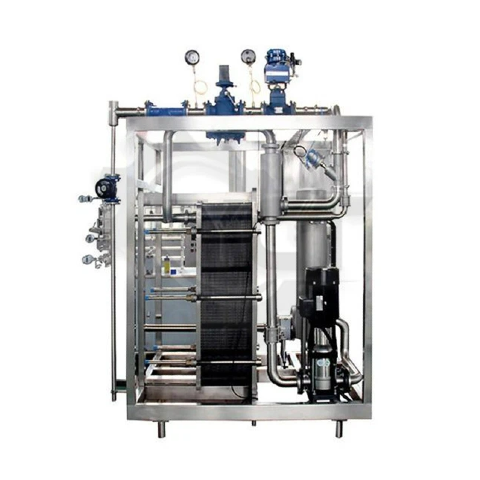
A Flash Pasteurizer can be used for a wide range of liquid products. Common examples include milk, flavored milk, juice, tea drinks, alcohol-based beverages, and other processed liquid foods. This makes the system useful for manufacturers serving different beverage categories or planning broader product development.
The flexibility of application is one reason why the equipment is so common in beverage production. Instead of being limited to one narrow product type, it supports a range of liquid formulations that need controlled heat treatment. This gives producers more room to develop and expand their product lines while using a practical pasteurization platform.
Even when the same machine type is used, not every beverage should run under the same exact settings. Sugar content, acidity, viscosity, solids, and other product characteristics influence how the liquid behaves during processing. A clear juice, a milk drink, and a pulp-containing beverage may all require different operating attention.
This is why real process performance depends on matching the system to the product. Understanding the beverage itself helps manufacturers decide how to set the line for better treatment stability and better final quality. The machine provides the process structure, but the product determines how that structure should be applied in practice.
One reason flash pasteurization is widely used is efficiency. The system is designed for continuous in-line treatment, which supports smoother production flow and better use of plant time. Instead of working through slower batch handling, the product moves through the line in an organized and controlled sequence.
Heat recovery also contributes to efficiency in many systems. By using thermal energy more effectively, the line can reduce unnecessary energy burden and support more economical operation. For manufacturers producing medium or large beverage volumes, this kind of design can make daily production more practical and more stable.
Efficiency also depends on control. A good Flash Pasteurizer should be easy to operate, easy to monitor, and able to repeat process conditions reliably. When the system is controlled well, the factory can achieve more consistent treatment results across different runs.
That consistency matters because production efficiency is not only about speed. It also depends on reducing process variation, limiting avoidable downtime, and helping operators manage the line with confidence. In real production, repeatability is one of the strongest advantages of a properly designed pasteurization system.
One common misunderstanding is that a fast process must be a weak one. In reality, the strength of flash pasteurization comes from precise control, not from long treatment time. The process is designed to act quickly but effectively, which is why the heating, holding, and cooling stages all matter.
A shorter treatment path does not mean lower value. It means the product is handled through a more efficient thermal cycle. When the system is designed and operated properly, fast treatment can support both product safety and commercial quality at the same time.
Another misunderstanding is that pasteurization performance depends only on temperature. In fact, the result depends on a balance of time, temperature, flow stability, and hygiene conditions. If one part of that balance is weak, the overall process becomes less reliable.
That is why a Flash Pasteurizer should be understood as a controlled system rather than a simple heating device. Good results come from the coordination of equipment design, operating conditions, and sanitation management. For buyers, this broader understanding is important because it connects machine function with real production performance.
Process Stage | What Happens | Main Equipment Section | Why It Matters |
Rapid heating | Product temperature rises quickly | Heat exchange section | Reaches treatment target efficiently |
Controlled holding | Product stays at target condition briefly | Holding tube or holding section | Supports the intended pasteurization result |
Rapid cooling | Product temperature drops quickly | Cooling section | Reduces extra heat exposure |
Line transfer | Product moves to the next stage | Piping, valves, tanks | Supports smooth downstream handling |
Continuous control | Process remains stable during operation | Control system | Improves repeatability and efficiency |
A Flash Pasteurizer works through a precise sequence of rapid heating, controlled holding, and fast cooling, making it a practical solution for many dairy and beverage lines. The system is valued not only because it treats liquid products efficiently, but because it supports stable quality, smoother production, and more reliable line performance when properly integrated. Shanghai QingJi Beverage Machinery Co., Ltd. provides practical processing equipment for milk, juice, tea, and other beverage projects. If you are planning a production line upgrade or a new processing project, contact us to learn how the right HTST pasteurization equipment can support your operation.
A Flash Pasteurizer works by heating a liquid product quickly, holding it at the target temperature for a short time, and then cooling it rapidly before the next production stage.
It can handle milk, milk beverages, juice, tea drinks, alcohol-based beverages, and other liquid products that require controlled pasteurization.
Rapid cooling helps reduce unnecessary heat exposure and prepares the product for storage, filling, or downstream handling.
Usually not. It often works together with equipment such as separators, homogenizers, tanks, or degassers as part of a complete beverage processing line.


