

Views: 0 Author: Site Editor Publish Time: 2026-08-03 Origin: Site


Beverage brands face a crucial tension as they scale their operations. You want the shelf stability required for wider distribution, but you cannot destroy the artisanal flavor profile responsible for your early success. Balancing these dual demands dictates your long-term growth trajectory.
Traditional thermal processing exposes liquids to excessive heat over prolonged periods. This clumsy approach often results in "cooked" off-flavors, severe protein denaturation, and the loss of delicate aromatics. Customers quickly notice when a vibrant, fresh product suddenly tastes flat or artificially processed.
A flash pasteurizer resolves this dilemma by utilizing High-Temperature Short-Time (HTST) principles. It neutralizes spoilage microorganisms while fiercely protecting delicate volatile compounds. In this article, you will discover why integrating this technology becomes a critical capital expenditure for scaling operations.
Growing a beverage brand eventually forces a difficult logistical transition. Early success often relies on cold-chain distribution. You brew or blend locally. You ship in refrigerated trucks. Retailers keep your product in cold cases. However, cold-chain logistics consume massive operational budgets. Expanding into regional or national retail markets requires an extended shelf life. Grocery chains often reject products carrying short expiration dates. You must achieve ambient shelf stability to scale.
Securing this shelf life introduces the threat of thermal degradation. Pasteurization relies on heat to kill spoilage microorganisms. Unfortunately, excessive heat exposure causes irreversible damage to your product. Time-temperature abuse strips away volatile aromatics. Craft brewers lose prized hop terpenes. Juice manufacturers lose vibrant, fresh-picked citrus notes. Prolonged heat also triggers unwanted Maillard reactions. Amino acids react directly with reducing sugars. Your beverage darkens in color. A distinct "cooked" or caramel off-flavor dominates the palate.
You must meet a very specific requirement to succeed. You must hit target Pasteurization Units (PUs) to ensure absolute microbial safety. One PU equals one minute of heat exposure at 60°C. Different beverages require different PU targets based on their pH and microbial load. The ultimate goal is hitting this target while minimizing the total thermal load. You need precision. You must destroy the microbes before the heat destroys your flavor profile.
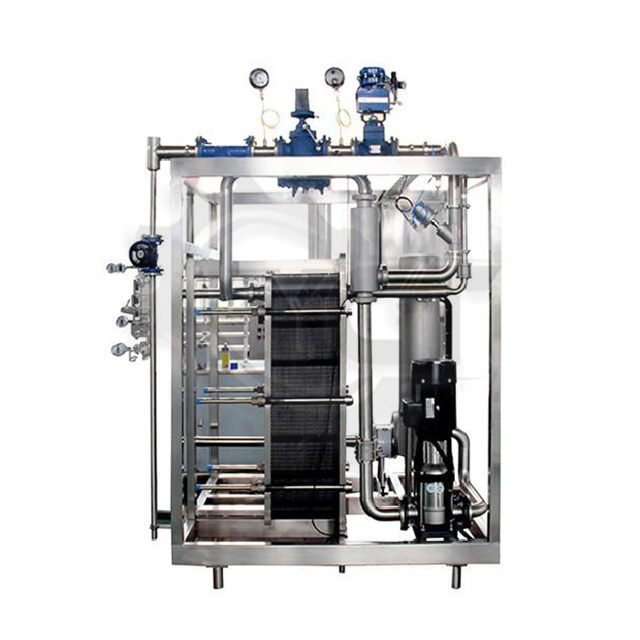
A flash pasteurizer protects flavor through strict adherence to the High-Temperature Short-Time (HTST) principle. This method relies on absolute precision. The system heats the liquid to a high target temperature. Typical ranges sit between 71°C and 74°C. The holding tube keeps the liquid at this exact temperature for only a fraction of a minute. Most cycles last 15 to 30 seconds. This brief exposure achieves microbial lethality. The short duration prevents heavy thermal damage.
The efficiency of this process depends heavily on plate heat exchangers. These components feature alternating series of corrugated stainless steel plates. The liquid flows across one side of the plate. The heating or cooling medium flows across the other. The true innovation lies within the regeneration section. Hot, fully pasteurized liquid exits the hold tube and enters this section. Simultaneously, cold, raw liquid enters the opposite side. The outgoing hot liquid warms the incoming cold liquid. This brilliant exchange recovers up to 90% of thermal energy. It radically reduces your boiler and chiller demands.
Rapid chilling finalizes the flavor preservation process. The liquid exits the regeneration section and immediately hits the chilling section. Glycol drops the beverage temperature back down to 2°C or 3°C almost instantly. This sudden temperature drop "locks in" the desired flavor profile. It halts any lingering chemical reactions. Furthermore, rapid cooling prevents severe protein denaturation. Preserving these proteins remains essential for maintaining rich mouthfeel in juices and robust foam retention in craft beers.
Evaluating your thermal processing options requires understanding the trade-offs of each technology. Tunnel pasteurizers represent a common alternative. These systems process packaged goods. You fill the bottles or cans first, then run them through a massive heated tunnel. This approach eliminates post-fill contamination risks. However, the process is painfully slow. Containers slowly heat up, hold temperature, and slowly cool down. This long residence time drastically increases the thermal load. The flavor often degrades. Additionally, tunnel systems demand massive amounts of floor space.
Some operations consider extreme heat methods. A UHT sterilizer (Ultra-High Temperature) pushes liquids past 135°C for just 2 to 5 seconds. This achieves commercial sterility. You gain ambient shelf stability for many months. However, the outcomes carry significant drawbacks. The extreme temperatures severely alter delicate flavors. They often create a burnt or cooked profile unsuitable for premium craft beverages. UHT systems also demand exceptionally high CapEx.
Flash pasteurization occupies the sweet spot. It sits perfectly on the spectrum between a basic batch pasteurizer and sterilizer system and an extreme UHT line. HTST technology remains ideal for craft beer, cider, fresh juices, and specialized dairy products. It delivers commercial safety while retaining premium taste.
Table 1: Thermal Processing Methods Comparison
| Processing Method | Temperature Range | Hold Time | Flavor Impact | Footprint |
|---|---|---|---|---|
| Batch Pasteurization | 63°C - 65°C | 30 Minutes | Moderate to High Degradation | Small to Medium |
| Tunnel Pasteurization | 60°C - 65°C | 20 - 30 Minutes | Moderate Degradation | Very Large |
| Flash Pasteurization (HTST) | 71°C - 74°C | 15 - 30 Seconds | Minimal Degradation | Compact / Skid |
| UHT Sterilization | 135°C - 145°C | 2 - 5 Seconds | High (Cooked Profile) | Large |
Integrating a flash pasteurizer requires careful facility planning. First, evaluate the footprint and modularity of the system. Space-constrained facilities benefit greatly from compact, skid-mounted units. Manufacturers build these systems on a single stainless steel frame. They arrive pre-piped and pre-wired. This modular approach minimizes installation downtime. You can slide the skid into a tight production floor corner and connect the utilities relatively quickly.
Next, you must ensure strict equipment compatibility. The pasteurizer does not operate in isolation. It must seamlessly integrate with upstream processes like brite tanks and blending vats. If your facility utilizes legacy dairy processing equipment, ensure the pipe fittings and sanitary connections match. Flow rates between blending tanks and the pasteurizer must remain synchronized.
Automation and quality assurance dictate the reliability of your integration. Modern HTST systems rely heavily on Programmable Logic Controller (PLC) controls. These computers monitor temperatures multiple times per second. If the temperature drops below the required threshold, an automatic divert valve instantly triggers. The system redirects the under-processed liquid back to the balance tank. It never reaches the filler. Furthermore, automated data logging records every minute of operation. This data proves vital for FDA and FSMA compliance audits.
Flow rate scalability is the final integration dimension. You must match the machine capacity to your filler speed. Machine capacities typically range from a few hundred to several thousand liters per hour.
Matching these speeds prevents continuous start/stop cycles. Frequent stopping causes liquid to sit in the heat exchanger, leading to immediate over-pasteurization and ruined flavor.
Buying the equipment represents only the first step. You must transparently assess the necessary infrastructure upgrades required to run the machine. Utility loads often surprise new buyers. Flash pasteurizers require substantial boiler capacity for the steam heating phase. Even with highly efficient regeneration sections, you need reliable steam pressure to maintain the hot water loop. Simultaneously, you need substantial glycol chiller capacity. The rapid cooling phase demands massive heat extraction. If your current chiller struggles during peak summer months, adding a flash pasteurizer will overwhelm it.
Sanitary downstream requirements introduce a critical operational risk. Flash pasteurization occurs exactly *before* packaging. The machine outputs a microbiologically stable liquid. However, it flows into your filler. If your filling equipment harbors bacteria, you will contaminate the pristine liquid. Filling equipment must be meticulously sanitized. You must upgrade your packaging room hygiene to prevent post-processing spoilage.
Finally, you must master Clean-in-Place (CIP) operations. Running organic liquids through tight plate heat exchangers creates bio-fouling. Proteins and minerals bake onto the hot plates. You must deploy integrated CIP systems daily. This involves circulating caustic and acid solutions at high temperatures. Facility managers must budget for increased chemical costs. Furthermore, operator training becomes paramount. An improperly executed CIP cycle leaves dangerous residue behind. Excellent plate hygiene ensures optimal heat transfer and absolute product safety.
Flash pasteurizers offer the most commercially viable path to preserve flavor while effectively extending shelf life. They solve the core scaling dilemma. By utilizing precise HTST principles, you achieve necessary microbial lethality without sacrificing the delicate aromatics and mouthfeel your customers love.
When shortlisting equipment, apply strict evaluation logic. Audit your existing boiler and chiller utility capacities immediately. Calculate your required flow rates based directly on your current and projected filler speeds. Most importantly, define your non-negotiable flavor metrics before running initial trials.
Your next step requires technical validation. Consult with an equipment engineer to run a comprehensive utility load calculation for your specific facility. Alternatively, request a custom ROI analysis based on your currently projected spoilage rates and expanded distribution footprint.
A: A flash pasteurizer typically delivers between 15 and 50 PUs, depending heavily on the product. Operators can easily adjust both the flow rate and the target temperature via the PLC. This flexibility allows you to hit specific PU targets. Beer might require 15 PUs, while a higher-pH juice might demand 30 PUs to achieve microbial stability.
A: Standard plate heat exchangers struggle with high-pulp or highly viscous liquids, as particulates quickly clog the narrow plate channels. For high-particulate beverages, you need tubular heat exchangers instead. These systems utilize concentric tubes that easily pass pulp and fibers while still delivering efficient HTST thermal transfer.
A: Flash pasteurization does not inherently require fully aseptic filling, but it demands an ultra-clean environment. Fully aseptic filling allows ambient storage without preservatives. Ultra-clean filling significantly reduces contamination but still requires a cold chain for extended stability. You must meticulously sanitize your downstream fillers to prevent reintroducing spoilage microbes into the pasteurized liquid.


