

Views: 0 Author: Site Editor Publish Time: 2025-10-24 Origin: Site


You need to pick the best way to sterilize and pasteurize milk in any Dairy processing line. Each way helps you keep milk safe and makes it last longer. There are strict rules for making milk. Food safety is not just about killing bacteria. It also means following national rules and keeping milk fresh.
Checking milk all the time keeps it safe and stops it from going bad.
The number of germs at first and how you store milk change how long it stays good.
You need to look out for germs that spoil milk to keep it safe.
Heat treatments like pasteurization and UHT kill germs and make milk safer.
New ways that do not use heat can also make milk safer and give people the healthy milk they want.
Picking the right way keeps your milk safe, fresh, and within the rules.
Pick the best sterilization method to keep milk safe and fresh. Think about how long milk should last and what safety rules you must follow.
Check milk quality often to stop it from going bad. Watching milk helps keep it safe and makes it last longer.
Know how pasteurization and sterilization are different. Pasteurization keeps more nutrients. Sterilization makes milk last longer.
Learn about your local food safety rules. Following these rules is important to avoid fines and keep people safe.
Look at what your business needs before you pick equipment. Choose a method that fits your production size and the milk quality you want.
Milk sterilization helps remove bad bacteria and germs from milk. Sterilization means you treat milk to kill all tiny living things. These can make milk spoil or make people sick. There are many ways to sterilize milk in big dairy factories. Some ways are ultra-high-temperature (UHT), batch sterilization, continuous sterilization, cooker-cooler systems, and hydrostatic sterilizers. Each way uses heat, pressure, or special tools to keep milk safe and fresh.
Sterilization Method | Description |
|---|---|
Heats products to 135°C to 150°C for a few seconds, achieving commercial sterility while preserving quality. | |
Processes products in discrete quantities, characterized by simplicity and flexibility. | |
Continuous Sterilization | Products flow through the system continuously, offering superior control and efficiency. |
Cooker-Cooler Systems | Versatile systems for both liquid and packaged products, ensuring optimal heat recovery and energy efficiency. |
Hydrostatic Sterilizers | Uses water columns to create pressure differentials for sophisticated sterilization without compromising sterility. |
There are also new ways like electron beam sterilization, pulsed electric fields, and high-pressure treatments. These help keep milk good and make it last longer.
Sterilizing milk keeps you and others safe from germs. If you skip sterilizing, milk can get bacteria and germs. This can cause sickness and food poisoning. You need to stop germs like Salmonella and E. coli from staying in milk. Studies show that using heat and pulsed electric fields together lowers germs. For example, heating milk at 70°C for 15 seconds with pulsed electric fields can cut down E. coli by a lot.
Tip: Sterilizing milk helps it last longer, keeps it safe, and gives people the fresh milk they want.
You have to follow strict rules when sterilizing milk. Government groups make rules to stop bacteria and keep people healthy. These rules say you must use ways that kill germs and lower bacteria. You need to check milk for germs and write down how you sterilize it. If you do not follow the rules, you can get in trouble or have to take milk off shelves. Pick sterilization ways that follow local and world rules so your milk is safe for everyone.
Pasteurization makes milk safe to drink. In a pasteurization plant, milk is heated for a certain time. This kills bad germs and bacteria. Scientists found the best time and temperature for safety. If you follow these steps, milk will not have dangerous pathogens. Pasteurization helps meet safety rules and keeps milk fresh longer.
Pasteurization heats milk for a set time.
Studies show this kills harmful germs in milk.
Good pasteurization gives safe, pathogen-free milk.
HTST pasteurization is used in many plants. Milk is heated to 72 °C for 15 seconds. This high heat for a short time kills most germs. Milk moves quickly and smoothly through the system. HTST pasteurization stops bacteria and enzymes fast. This keeps the taste and quality of milk good. HTST systems let you process a lot of milk quickly.
HTST pasteurization uses 72 °C for 15 seconds.
Milk flows fast and efficiently.
This method lowers microbes and keeps milk quality.
Batch pasteurization is another way to make milk safe. Milk is heated in big tanks for longer. This way is slower than HTST pasteurization. Milk flow stops and starts with each batch. Batch pasteurization uses more energy and space. HTST pasteurization is faster and uses less energy. Batch pasteurization works well for small amounts or on farms.
HTST systems are more efficient than batch pasteurization.
HTST lets you process more milk in less space.
Batch pasteurization is good for small or on-farm use.
You should know the good and bad sides of pasteurization. The table below shows how HTST pasteurization compares for commercial use:
Advantages of HTST Pasteurization | Disadvantages of HTST System |
|---|---|
You can process a lot of milk all the time. | The system does not work well for small amounts of different milk products. |
Automatic controls make sure pasteurization is done right. | Gaskets need to be checked often for leaks and cleanliness. |
The equipment does not need much floor or plant space. | It needs special instruments for control. |
The system is easy to clean with CIP cleaning. | You cannot drain it fully without losing some milk. |
Filling can start almost right away. | Long runs may cause bacteria problems; clean the plant every six to eight hours. |
HTST saves money by using a regenerator. | N/A |
The whole system is simple and needs little watching. | N/A |
You can add more plates to increase capacity without using more space. | N/A |
It works well for heating and cooling again and again. | N/A |
The closed unit keeps milk losses low. | N/A |
Tip: When picking a pasteurization plant, think about your milk flow, how much pasteurized milk you need, and if you want to pasteurize on a farm. HTST pasteurization is best for big amounts and high efficiency. Batch pasteurization is better for small or on-farm needs.
You use in-bottle sterilization to make milk safe for long storage. This process treats milk after you fill it into bottles. You must follow each step carefully to keep the milk safe and fresh. Here is how the process works:
Check the raw milk for physic-chemical and bacteriological quality.
Cool the intake milk to 5°C for bulk storage.
Preheat the milk to 35-40°C for filtration and clarification.
Cool the milk again to 5°C to keep its quality.
Standardize the milk to the right fat and solids-not-fat content.
Preheat to 60°C for homogenization at 2500 psi.
Clarify the homogenized milk to remove sediment.
Fill cleaned and sanitized bottles with hot milk and seal them.
Sterilize the filled bottles at 108-111°C for 25-35 minutes.
Gradually cool the sterilized bottles to room temperature.
Store the milk-in-bottles in a cool place.
You must pay close attention to initial cleaning and sterilization of bottles. This step is key for quality control and safety.
In-bottle sterilization gives you several benefits:
You can store milk for a long time without refrigeration.
The process kills almost all bacteria and spores.
You can use this method for many types of milk products.
The process is simple and does not need complex equipment.
Note: This process helps you meet strict quality control standards and keeps your milk safe for consumers.
You may face some drawbacks with in-bottle sterilization:
The process uses high heat for a long time, which can lower some nutrients.
You need to spend more time and energy compared to other methods.
Initial cleaning and sterilization of bottles must be perfect to avoid spoilage.
The process can change the taste and texture of milk.
In-bottle sterilization affects milk quality in several ways:
You lose some vitamins, such as B1, B12, and C. Losses of B12 can reach up to 90%.
Fat, fat-soluble vitamins, carbohydrates, and minerals stay mostly the same.
Proteins and water-soluble vitamins break down more, which lowers the digestibility and biological value of milk.
The process can change the flavor and color of milk, making it taste cooked or caramelized.
Tip: If you want to keep more nutrients and a fresh taste, you may want to look at other sterilization methods.
Ultra-high temperature processing helps keep milk safe for a long time. UHT heats milk to very high temperatures for only a few seconds. This method uses special machines to control the heat exactly. Most of the time, milk is heated to about 142°C for around 4 seconds. Some machines use temperatures from 137°C to 145°C. The table below shows the main heat and time settings for UHT:
Temperature (°C) | Time (seconds) |
|---|---|
142 | 4.35 |
137 - 145 | N/A |
You need special equipment for UHT. These machines heat milk quickly and keep the temperature steady. UHT is not the same as pasteurization. UHT uses higher heat and less time.
UHT processing has many good points for making milk in factories. You can keep UHT milk for months without a fridge. This saves money and lets you sell milk in more places. UHT kills bad bacteria and germs, so milk is safer. Most of the milk’s nutrients stay the same. The table below lists the main benefits:
Benefit | Description |
|---|---|
Extended Shelf Life | UHT milk can be stored for several months without refrigeration |
Food Safety | UHT processing eliminates harmful bacteria and microorganisms |
Nutritional Retention | UHT milk retains most of its original nutritional content |
UHT milk stays good for months without a fridge.
It lowers the chance of bacteria in milk.
UHT makes milk safer, even where fridges are not common.
You can use UHT where it is hard to keep milk cold. This method helps you follow food safety rules and keeps milk fresh longer.
There are some problems with UHT processing you should know. UHT can destroy some nutrients, enzymes, and proteins in milk. This can make milk harder to digest. Some people have trouble digesting UHT milk because the proteins change. The chance of allergies may go up, especially for people who are sensitive. UHT milk can taste strange or have a weird texture, so some people may not like it. The table below shows the main drawbacks:
Drawback | Description |
|---|---|
Nutrient Loss | UHT processing kills off valuable nutrients, enzymes, and proteins, significantly affecting digestibility. |
Digestibility | Denatured proteins in UHT milk make it harder to digest, leading to potential intolerance issues. |
Allergenicity | Altered protein structures may increase the risk of allergic reactions, particularly in sensitive individuals. |
Sensory Qualities | UHT milk can develop off-flavors and undesirable textures, impacting consumer acceptance. |
UHT can cause problems in cells if used too much.
Some studies worry about UHT milk and cell changes.
More kids are getting eosinophilic esophagitis since UHT milk became common.
Many people do not trust UHT milk. Some call it "dead" milk because the high heat changes it a lot.
UHT changes how milk tastes and what is in it. UHT milk can taste like eggs or sulfur. This happens because of chemicals made by the heat. Other ways, like retort and autoclave, make milk taste caramel-like. These flavors come from heating reactions. Different heat treatments change how milk tastes and smells. UHT milk keeps most nutrients, but some vitamins and proteins break down. You need to think about shelf life, taste, and nutrition when picking UHT or pasteurization.
Tip: If you want milk that tastes fresh and has more nutrients, you might like pasteurization better. UHT is best if you need milk to last a long time and stay safe without a fridge.

Aseptic packaging helps milk stay safe and fresh for a long time. There are three main steps in this process. First, you heat the milk to a very high temperature. This is usually done with UHT systems. The milk gets hotter than 275°F for at least two seconds. Next, you make the packaging material germ-free. You can use hot steam or hydrogen peroxide for this step. Last, you fill and seal the milk in a clean area. This keeps germs from getting into the milk.
Aseptic packaging takes out bacteria and viruses from milk. It also stops new germs from getting in during packaging. This makes milk safer and helps it last longer for stores and companies.
Aseptic packaging has many good points for selling milk:
Milk can be stored for six to twelve months without a fridge.
Less milk goes to waste because it lasts longer.
You save money because you do not need cold trucks or storage.
Lighter packages make shipping cheaper and lower pollution.
People can buy single-serve milk that is easy to carry.
You can sell milk in more places, even where there are no fridges.
There are some problems with using aseptic packaging for milk. These include:
Challenge Type | Description |
|---|---|
Technical Problems | You need to use special machines and tools. |
Legal Complications | You must follow strict rules for labels and selling. |
Lack of Definitions | Sometimes it is not clear what counts as sterilized milk. |
Quality Control | You have to check the milk to keep it safe. |
Microbiological Safety | You must stop germs at every step of the process. |
Different dairy products may need different ways to keep them safe and good.
Aseptic packaging makes milk last much longer for stores. Milk can stay fresh for six to twelve months without a fridge. This is much longer than regular packaging, which needs cold storage and can change milk’s taste or feel. Aseptic packaging lets you sell milk in more places and cuts down on spoiled milk, especially where it is hard to keep things cold.
Electron beam sterilization makes milk safer without using heat. This method uses strong electron beams to kill germs in milk. It works quickly and does not heat up the milk. Milk lasts longer and is safer after this process. The electron beam attacks bad germs, but how deep it goes depends on its power. If the beam is too strong, it can change how milk tastes or feels. Many dairy companies like this way because it leaves no harmful leftovers and is very safe.
There are more new ways to sterilize milk. Some companies use ultraviolet light. UV light keeps milk’s taste and nutrition, but it works best with clear milk. Chemical sterilization is another way. It helps milk last longer at room temperature and works for both milk and its package. But you must follow strict rules, and chemicals can leave some leftovers.
Here are the main good and bad points of these new methods:
Method | Pros | Cons |
|---|---|---|
Electron Beam | Works well, no leftovers, very exact | Costs a lot, needs special machines |
UV Sterilization | Keeps nutrition, saves energy | Not good for cloudy milk |
Chemical Sterilization | Makes milk last longer, works on packaging | Must follow rules, may leave chemicals |
Tip: Pick the method that fits your milk and your business best.
You can use electron beam machines in your dairy plant. They are small and do not use much energy. Some can even clean hard-to-reach places in your machines. Many big dairy companies are starting to use this technology. It helps keep milk safe and makes work easier. More dairy plants will use these new sterilization ways soon.
When you pick a milk sterilization method, you must think about cost, size, quality, shelf life, and rules. Each method has good and bad points. This guide helps you look at the main choices.
You want to know how much each method costs and if it fits your dairy size. Some ways are best for small dairies. Others work better for big factories. The table below shows the usual prices for different machines and sizes:
Scale of Operation | Equipment/Method | Cost Range |
|---|---|---|
Small Scale/Startups | Efficient Sterilizer | $569 - $799 |
500L Pasteurization Tank | $950 | |
Automatic Small Juice Machine | $435 - $475 | |
Mid-Scale Operations | Coil UHT Electric Heating system | $1,950 - $2,480 |
Continuous HTST Plate Pasteurizer | $2,600 | |
Continuous Electric 1000L Pasteurizer | $14,999 | |
Large-Scale/Industrial | Tubular UHT Milk Sterilizer | $28,000 - $35,000+ |
Automatic Multifunctional Machine | $1,000 - $1,500 |
Pasteurization tanks and small sterilizers cost less money. UHT and continuous systems cost more but can handle more milk. If you have a big dairy, you might need to buy advanced machines.
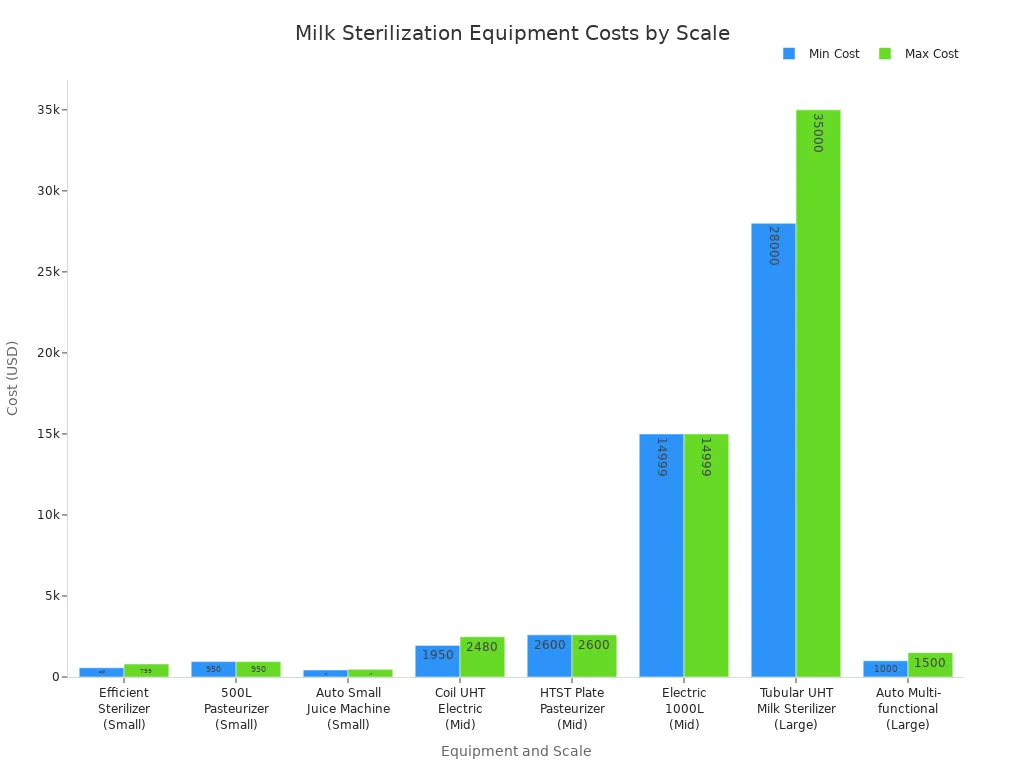
Tip: Small dairies and new businesses often use batch pasteurization or small sterilizers. Big companies use UHT, HTST, or electron beam systems to make more milk.
You want milk that tastes good and lasts longer. Different methods change milk’s taste, nutrition, and how long it stays fresh. Old ways like pasteurization and in-bottle sterilization kill germs well. But these can lower some nutrients because of high heat. UHT gives milk a longer shelf life, but some people think it loses nutrients and tastes different.
Newer ways, like electron beam and UV-C radiation, keep more nutrients and natural flavors. These are good for milk that does not like heat and help keep special parts in milk. High-pressure processing also keeps milk safe and healthy.
A study showed that heating and freezing can change milk’s protein and fat. This can change how healthy the milk is. Many people worry about UHT milk because they think it loses good stuff. You need to balance safety, shelf life, and taste when you choose a method.
Note: If you want milk to last longer, UHT and aseptic packaging are best. If you want milk to taste fresh and keep more nutrients, try pasteurization or new non-thermal methods.
You must follow strict rules for milk sterilization. Every country has its own laws for milk processing. Pasteurization meets most safety rules and is used almost everywhere. UHT and aseptic packaging also meet high safety rules and let you sell milk in more places.
Electron beam and UV methods need special approval. You must check local laws before using these new ways. In-bottle sterilization works for shelf-stable milk but needs careful cleaning and good records.
Method | Regulatory Acceptance | Notes |
|---|---|---|
Pasteurization | High | Standard for most markets |
UHT | High | Accepted for shelf-stable milk |
In-Bottle Sterilization | Moderate | Needs strict cleaning and documentation |
Aseptic Packaging | High | Requires validated process |
Electron Beam | Varies | Needs special approval |
UV/High Pressure | Emerging | Approval depends on region |
Tip: Always check your local and export rules before picking a milk sterilization method. This helps you avoid trouble and keeps your milk safe.
This table helps you compare the main milk sterilization methods for cost, size, quality, shelf life, rules, and what people think:
Method | Cost & Scale | Product Quality | Shelf Life | Regulatory Compliance | Consumer Perception |
|---|---|---|---|---|---|
Pasteurization | Low-Mid, scalable | Good, some nutrient loss | Days to weeks | High | Trusted, fresh taste |
In-Bottle Sterilization | Low-Mid, small scale | Lower, cooked flavor | Months | Moderate | Acceptable, shelf-stable |
UHT | High, large scale | Lower, altered taste | Extended shelf life | High | Mixed, "dead milk" label |
Aseptic Packaging | High, large scale | Good, depends on process | Extended shelf life | High | Positive, convenient |
Electron Beam/Advanced | High, scalable | High, retains nutrients | Extended shelf life | Varies | Growing interest |
Note: You should match your business goals with the right milk sterilization method. Think about your budget, your market, and what your customers want.
You need to start by looking at what your business needs most. Every dairy processing line has different goals. Some focus on high output, while others want to keep milk as fresh as possible. You should ask yourself a few key questions:
How much milk do you process each day?
Do you want a longer shelf life or a fresher taste?
What is your budget for new equipment?
Do you sell milk locally or ship it far away?
What are your local food safety rules?
You can use a table to help you check important criteria for your dairy processing line:
Criteria | Description |
|---|---|
Flow Control Device | Seal the device at a set flow rate. This keeps milk at the right temperature for the right time. |
Maintenance | Check and seal the flow control device when you install it and every year after. Keep records of any changes. |
Heating Section | Make sure the heating is fast and even. Use good steam injectors to avoid hot or cold spots. |
Safety Systems | Do not let milk bypass the flow control device. Use safety switches to stop unsafe processing. |
Tip: Write down your answers and compare them to your business goals. This helps you pick the best method for your dairy processing line.
You need the right equipment for your dairy processing line. Some methods need simple machines, while others use advanced technology. Think about your current setup. Can you add new machines, or do you need to replace old ones? Look at your space, power supply, and staff skills.
Batch pasteurization works well with basic tanks and heaters.
HTST and UHT systems need more space and special controls.
Electron beam and aseptic packaging need high-tech machines and trained workers.
You should also plan for regular maintenance. Keep your machines clean and check them often. Good equipment helps you make safe milk and avoid breakdowns.
Note: Always train your staff on new machines. This keeps your dairy processing line running smoothly and safely.
You must balance milk quality with food safety rules. Some methods keep more nutrients and taste, but others give you a longer shelf life. You need to follow all local and national laws for your dairy processing line.
Pasteurization is trusted and meets most rules.
UHT and aseptic packaging help you sell milk in more places.
New methods like electron beam may need special approval.
Make sure you keep records of your process. Check your flow control devices and safety systems every year. This helps you pass inspections and keeps your milk safe.
Tip: Talk to local food safety experts before you change your dairy processing line. They can help you follow the rules and avoid problems.
You can follow these steps to choose and set up the right method for your dairy processing line:
List your business goals and needs.
Check your current equipment and space.
Compare different sterilization methods using a table or checklist.
Talk to equipment suppliers and food safety experts.
Choose the method that fits your goals, budget, and rules.
Train your staff on new machines and safety steps.
Keep good records of your process and maintenance.
Review your process every year and make changes if needed.
Remember: The best method for your dairy processing line matches your business goals, keeps milk safe, and follows all rules.
You can sterilize and pasteurize milk in different ways. Each way has good and bad sides. Pasteurization keeps milk fresh, but you must keep it cold. UHT and aseptic packaging help milk last much longer. New methods like electron beam save more nutrients in milk. You should think about how big your business is. Also, think about what you want your milk to be like and what rules you must follow. Ask experts for advice before you choose a method.
Keep learning about new technology so your dairy stays safe and works well!
Pasteurization heats milk to kill most germs. Sterilization uses higher heat or other ways to kill all germs and spores. Sterilized milk lasts longer, but pasteurized milk keeps more nutrients and tastes fresher.
Yes, you can keep UHT milk at room temperature before opening it. After you open it, put it in the fridge and drink it in a few days.
Sterilization can make milk taste different. It may taste cooked or like caramel, especially with in-bottle or UHT. Pasteurized milk tastes more fresh.
Method | Best For |
|---|---|
Batch Pasteurization | Small dairies |
HTST/UHT | Large operations |
If you have a small dairy, use batch pasteurization. It costs less money and uses simple machines.
Yes, electron beam sterilization is safe if you use it right. You do not add chemicals. More nutrients stay in the milk. Always follow safety rules and check your local laws.


