

Views: 0 Author: Site Editor Publish Time: 2025-10-27 Origin: Site


You use pasteurization, sterilization, and other heat methods to keep dairy safe and fresh. These methods are very important for food safety and keeping food good longer. Pasteurization kills bad bacteria. Sterilization goes further and kills even stronger germs. Studies show these steps help milk last longer and taste better. But you still need good packaging and food safety plans like haccp. Some bacteria can survive or come back after processing. The Dairy processing line uses these steps to make high-quality dairy products.
Pasteurization is very important for dairy safety. It kills bad bacteria but keeps milk fresh and healthy.
Sterilization gives dairy the longest shelf life. It removes all germs but can change the taste and lower some vitamins.
Different heat methods change dairy quality and safety. Pick pasteurized milk for freshness. Pick sterilized milk if you need to store it longer.
Thermization and UHT processing help keep milk’s natural qualities. These ways are good for cheese and foods that last a long time.
Always look for 'pasteurized' on dairy labels. This keeps you safe and lowers the chance of getting sick from food.
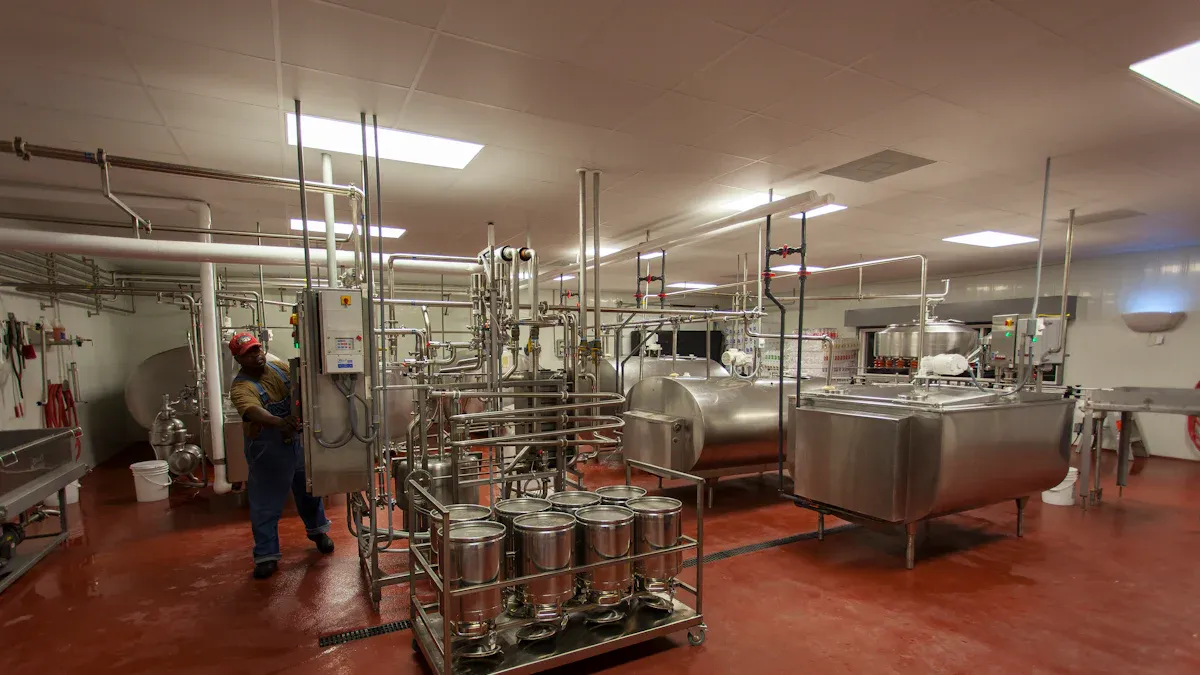
Pasteurization helps make dairy safe for you and your family. It is a heat process that warms milk to a set temperature for a certain time. This kills germs that can make you sick. Pasteurization keeps the taste, nutrition, and look of milk. Louis Pasteur made this method to stop people from getting sick from food. In dairy plants, pasteurization means heating all the milk in special machines to kill bad germs. Pasteurization lets you enjoy dairy without worrying about safety.
Pasteurization uses many steps to keep milk safe and good. Each step in the dairy plant helps remove germs and keep milk fresh.
Chilling: Milk is cooled fast to stop germs from growing.
Pre-heating: Milk is warmed to 40°C with a special heater.
Clarification: Machines spin milk to take out dirt and bits.
Standardisation: Cream is added back to milk for even quality.
Homogenisation: Milk fat is broken up so cream does not rise.
Heating section: Milk is heated to 72°C to kill bad germs.
Holding section: Milk stays at this heat for at least 16 seconds.
Cooling/chilling section: Milk is cooled to 4°C before packing.
These steps help modern pasteurization keep dairy safe and fresh.
There are different ways to pasteurize milk in the dairy industry. Each way uses its own heat and time to make milk safe and good.
Pasteurization Method | Temperature (°C) | Time |
|---|---|---|
High Temperature Short Time (HTST) | 72 | 15 seconds |
Low Temperature Long Time (LTLT) | 63 | 30 minutes |
Ultra-pasteurization (UHT) | 135–150 | 2–5 seconds |
Flash Pasteurization | 85–95 | Few seconds |
HTST is the most used way in dairy plants. HTST uses high heat for a short time to kill germs fast. Ultra-pasteurization uses even hotter heat for a very short time. You see ultra-pasteurization in shelf-stable milk and cream. These ways help you pick the right dairy for your needs.
Pasteurization gives you many good things. The biggest is safety. Pasteurization lowers the chance of getting sick from dairy. Before pasteurization, raw dairy caused about 25% of food sickness. After pasteurization, this dropped to only 2%. You are 838.8 times more likely to get sick from raw dairy than pasteurized. You also have a much bigger chance of going to the hospital with raw dairy.
Raw dairy causes hundreds of sicknesses and hospital visits each year in the U.S.
Most sickness comes from germs like Salmonella and Campylobacter.
You lower your risk when you pick pasteurized dairy.
Pasteurization also keeps milk tasting good and full of nutrients. It helps milk stay fresh longer. You use heat processing to make milk last and keep its quality. These ways help you enjoy safe and tasty dairy every day.
Tip: Pasteurization keeps you healthy and your dairy fresh. Pick pasteurized milk and dairy for better safety and quality.
Sterilization is a very strong heat process in dairy. It destroys all germs in milk, even the toughest ones. This includes bacteria, viruses, spores, and other harmful things. The process uses very high heat, usually above 100°C. This makes sure that germs like salmonella, listeria, and e. coli do not survive. Pasteurization only lowers the number of bad bacteria. Sterilization removes almost every living cell in the milk. After sterilization, almost no bacteria are left. You can keep sterilized dairy for months or years without a fridge.
Sterilization uses heat above 100°C to kill all germs, even spores.
Pasteurization only lowers bad bacteria and does not remove them all.
The F0 value shows how long you keep milk at 121.11°C to make sure it is fully sterilized.
Sterilized dairy can last for years if you store it right.
Note: Sterilization gives you the best food safety of all heat methods.
There are a few steps to sterilize dairy and make it last longer. Special machines use high heat to keep dairy safe and good.
Process Step | Condition/Details |
|---|---|
Heating | Milk is heated to very high temperatures (like 135°C) |
Duration | Kept hot for a short time (1-2 seconds) |
Method | Ultra-high temperature (UHT) processing |
Result | Sterile product, shelf-stable for 3 months |
First, you heat the milk to a very high temperature, about 135°C, for a short time. This step kills all germs and spores. Then, you use aseptic processing. This means you clean the package and fill it in a germ-free place. This keeps new germs out. The final product stays safe and fresh for months at room temperature.
You heat milk to kill all harmful germs.
You clean the package and fill it in a clean space.
The high heat kills almost all bacteria and germs.
Sterilization and pasteurization both use heat, but they are different. Pasteurization kills some bad bacteria and keeps milk tasting fresh. Sterilization kills all germs, even spores that can live through pasteurization.
Sterilization is better at killing germs and bacteria. The milk has almost no chance of germs left. You can keep sterilized milk for a long time without a fridge. Pasteurization only lowers the risk from some germs like salmonella and listeria. It does not remove all bacteria. You still need to keep pasteurized milk cold to keep it safe.
Tip: Pick sterilized dairy if you need it to last a long time without a fridge. If you want fresher taste and more nutrients, choose pasteurized milk.
Sterilization makes dairy very safe and last a long time. But it also changes the milk. The high heat destroys many vitamins, like B1, B6, B9, C, and A. Vitamins B2 and D2 stay better, but you still lose some. The process also makes it harder for your body to use calcium from the milk.
Sterilized milk can taste caramel-like and look darker. The texture may get softer or mushy. These changes happen because the high heat causes chemical changes in the milk. Pasteurized milk tastes fresher and has a better texture because it uses less heat.
Sterilization lets you keep dairy at room temperature, which helps in emergencies or places without fridges.
You may see changes in protein, fat, and lactose, which can change taste and how easy it is to digest.
Fat in the milk can change during storage, making it taste different and harder to digest.
Even though sterilized dairy lasts longer, it can still change in quality over time.
Remember: Sterilization gives you the safest and longest-lasting dairy, but it can change how your milk tastes, feels, and how healthy it is.
Thermization is a gentle way to heat milk. It uses lower heat than pasteurization. The temperature is between 57°C and 68°C for 15 seconds. This method helps keep milk safe and good. More natural enzymes and microflora stay in the milk. This makes cheese taste better and have a nicer texture. Many cheeses need thermized or raw milk to follow rules and keep their true flavor. You also get firmer curd and more cheese because calcium stays balanced.
Thermization keeps natural microflora and enzymes. This makes cheese taste richer.
You get better texture and body in aged cheese.
This method helps curd form and gives more cheese.
Thermization lowers bad bacteria but keeps milk’s special traits.
Ultra-high temperature is also called uht or ultra heat treatment. It is a popular way to heat dairy. You heat milk or other dairy above 140°C for two to five seconds. This kills almost all bacteria and spores. The products can last for months without a fridge. Uht is used for milk, cream, yogurt, fruit juice, soy milk, soup, wine, honey, and stew. Dairy plants use special machines that heat milk as it flows. Uht helps keep dairy safe and good for a long time.
Uht heats liquid food to 137°C–150°C for a few seconds.
You find uht in milk, cream, yogurt, and other foods.
This method makes dairy last longer and safer.
Microwave processing is a newer way to heat food. You use microwaves to warm dairy fast and save energy. This method heats quickly and keeps more nutrients. You can pack dairy before heating to stop germs from getting in. Microwave processing can lower bacteria by a lot in just 15–20 seconds at 70–75°C. You keep more immunoglobulins and vitamins B1 and E. But you must watch the process closely. Uneven heating can make some parts too hot and change proteins. Pressure can build up in packages and cause problems.
Tip: Microwave processing saves 10–15% energy and keeps more nutrients in dairy.
Many machines help heat dairy in the processing line. Plate heat exchangers (PHE) are common and heat milk well. These machines move heat quickly and control temperature. Tubular and shell-and-tube exchangers work for thick dairy. Scraped-surface exchangers are good for thick or chunky dairy. Regenerative exchangers save energy by using heat again. Clean-in-place exchangers (CIP) make cleaning easy and keep dairy good.
Equipment Type | Use in Dairy Processing Line |
|---|---|
Plate Heat Exchangers (PHE) | Heats and cools dairy fast |
Tubular/Shell-and-Tube Exchangers | Good for thick dairy |
Scraped-Surface Exchangers | Works for chunky or thick dairy |
Regenerative Exchangers | Saves energy |
Clean-in-Place (CIP) Exchangers | Easy to clean, keeps quality high |
You need these machines to make sure dairy is safe and high quality after heating.
When you pick dairy, you want it to be safe. Pasteurization uses heat to lower harmful bacteria like salmonella and listeria. This makes milk safer for you to drink. Sterilization uses more heat and kills almost all germs and pathogens. UHT and other heat methods also help keep dairy safe. The dairy processing line uses these steps to stop sickness. Studies show heat treatments, especially pasteurization, are important for food safety and keeping milk fresh. You should check for haccp plans in dairy plants to make sure safety is high.
Heat methods change how long you can keep dairy. Pasteurization lets you keep milk cold for 1 to 2 months. UHT milk can last 6 to 9 months without a fridge. Sterilization gives the longest shelf life. Here is a table to compare:
Dairy Product Type | Shelf Life (Months) | Storage Requirement |
|---|---|---|
UHT Milk | 6 to 9 | Shelf-stable, no refrigeration |
Traditional Pasteurized Milk | 1 to 2 | Requires refrigeration |
You can see that heat processing helps milk last longer and stay good.
Heat methods can change the nutrients in milk. Pasteurization keeps most vitamins and proteins in milk. You do not lose much vitamin A, E, or D. UHT and sterilization can lower B1, B12, and C by 10-20%. Bottle sterilization can cause up to 90% loss of B12. Sometimes, vitamins are added back after heating. Heating milk can also change proteins, which may help people with allergies. The dairy processing line often adds vitamins after heating to keep milk healthy.
Heat Treatment Method | Effect on Nutrients | Loss Percentage |
|---|---|---|
Pasteurization | Vitamin A | No change |
Pasteurization | Vitamin D | No change |
Pasteurization & UHT | B1, B12, C | 10-20% loss |
Bottle Sterilization | B12 | 90% loss |
Different dairy products use different heat methods. Pasteurization is best for fresh milk, cheese, and yogurt. UHT and sterilization are used for long-life milk, cream, custard, and flavored milks. UHT milk is not good for cheese because it makes the curd too soft. The dairy processing line picks the right heat method for each product. You see these ways to keep food safe in stores every day.
UHT is good for long-life cream and custard, but not for cheese.
There are big differences between pasteurization, sterilization, and other heat treatments. Each one changes how safe milk is, how long it lasts, and what nutrients it keeps.
Pasteurization keeps most nutrients in milk and makes it safe to drink every day.
Sterilization lets milk last the longest, but it can change the taste and lower some vitamins.
Gentle heat treatments help milk keep special things needed for cheese and yogurt.
Some people think pasteurization makes milk bad, but studies show only a few vitamins go down. Most protein and sugar stay the same.
Company | Innovation Description | Methodology Used |
|---|---|---|
FrieslandCampina | Made milk with more immunoglobulins | Gentle heat treatment |
Mengniu Dairy | Created a yogurt method that keeps immunoglobulins | Centrifugal sterilization and ultrafiltration |
You should choose the milk that fits what you need. Heat processing helps you stay healthy and enjoy safe dairy every day.
Pasteurization heats milk to kill most bacteria. Sterilization uses hotter heat to destroy all germs, even spores. Sterilized milk lasts longer on the shelf. Pasteurized milk keeps more nutrients and tastes fresher.
Yes, heat processing can change how milk tastes. Pasteurized milk tastes fresh. Sterilized and UHT milk can taste sweeter or like caramel. The texture can feel different, too.
Pasteurized milk is much safer to drink. It lowers your chance of getting sick from bacteria like Salmonella and E. coli. Raw milk can have germs that make you sick.
Tip: Always look for "pasteurized" on the label to keep your family safe.
You should not use UHT milk for cheese. UHT milk makes curds too soft and changes cheese texture. Pasteurized or thermized milk works better for making cheese.
Dairy plants use plate heat exchangers, tubular exchangers, and scraped-surface machines. These machines heat and cool milk fast. They help make dairy safe and high quality.


