

Views: 0 Author: Site Editor Publish Time: 2025-10-27 Origin: Site


Pick a spot near coconut farms to save money and time. Good location choice is very important for your plant to do well.
Use strong quality checks. Follow safety rules like HACCP and GMP to keep products safe and make customers trust you.
Buy new machines to work better. Automated machines help make products faster and better, and they lower worker costs.
Teach your workers well. Good training keeps standards high and helps your team fix problems fast.
Choose the right packaging to keep products safe. Use materials that keep coconut products fresh and follow labeling rules.
Set clear business goals before starting your coconut processing plant. These goals help you make smart choices. Most new coconut processing businesses focus on three things. They want to get coconuts easily, have good infrastructure, and find enough workers. These things help you save money and keep production running well.
Factor | Description |
|---|---|
Proximity to raw materials | Makes it easy to get coconuts and saves on transport. |
Access to infrastructure | Needed for smooth work, like roads and power. |
Labor availability | Helps your plant work well and saves money. |
Tip: Picking the right site is very important for saving money and working well. Always think about how close you are to coconuts, roads, and workers.
Pick a location that matches your business goals. Try to be close to coconut farms. This saves time and money when moving coconuts. Make sure the place has good roads, water, and electricity. Think about how your plant might affect the environment. Check how much it costs to build your plant in different places. This helps you avoid problems later.
Where you build your plant is very important.
The environment matters for future success.
Check costs before you decide where to build.
A good layout helps your Coconut Processing Line work well. You want to move things from one step to the next quickly. Put machines in smart spots so workers do not waste time. Use your space well to fit all your equipment and keep everyone safe.
Recommendation | Description |
|---|---|
Streamline flow of materials | Move things in a way that saves time. |
Facilitate smooth manufacturing | Set up steps to avoid waiting. |
Minimize materials handling/cost | Move things less to save money. |
Effective utilization of space | Use every part of your space well. |
Provide employee convenience | Make sure workers are safe and comfortable. |
Minimize overall production time | Set up work to finish faster. |
A smart layout can help you make more products and waste less time. When you plan your plant well, your team works better and makes great coconut products.
You need good coconuts to get the best results. Pick suppliers you can trust. Look for ones with certifications like ISO, HACCP, GMP, or Organic. These show the supplier follows strict rules. Use traceability tools to see where coconuts come from. Check and compare supplier offers and their past records on trusted sites like Freshdi. Make sure your supplier can deliver on time and handle big orders. Watch market trends and world coconut reports to help plan your buying.
Pick suppliers with certifications.
Use traceability tools to check sources.
Compare supplier offers and records.
Make sure they can deliver and handle big orders.
Watch market trends and reports.
Tip: Good sourcing helps you avoid delays and keeps your products the same every time.
Handling and storage keep coconuts fresh and safe. Store fresh coconuts between 0°C and 16°C. Mature coconuts do best at 8°C to 12°C. Keep humidity at 80% for mature coconuts and 90% for young coconuts. Use airtight, food-safe packaging to make coconuts last longer. Make sure your storage has good airflow to stop water from building up. Do not let coconuts get too hot or they will spoil.
Aspect | Recommended Range |
|---|---|
Optimum carrying temperature | 0°C to 1.5°C |
Highest freezing point | -0.9°C |
Acceptable loading temperature | Max. 2°C above carrying temp |
Optimum humidity | 75% to 85% |
Storage life | 2 months |
Mature coconuts ambient storage | 3 to 5 months |
Young coconuts storage | 3°C to 6°C with 90% to 95% RH |
Note: Always check the temperature and humidity in your storage area.
You must get coconuts ready before main processing. Pick mature coconuts and check each one for problems. Wash coconuts with strong water spray to get rid of dirt. Use a machine to take off the hard shell fast and safely. For coconut water, use clean tools to take it out and keep it pure.
Pick mature coconuts with no defects.
Wash with strong water spray.
Use machines to shell coconuts.
Take out coconut water with clean tools.
These steps help you get the best coconuts for your Coconut Processing Line. They also help your products meet high standards.
You have to follow strict safety standards in your coconut processing plant. These rules help keep your products safe and good quality. International rules show you what to do. Some important standards are:
International Featured Standard (IFS): This standard helps you check food safety and quality. It also makes audits easier and shows you safety steps.
Good Manufacturing Practices (GMP): GMP makes sure your products follow safety, quality, and legal rules.
Hazard Analysis Critical Control Point (HACCP): HACCP helps you find and control dangers in food making.
You need to watch key control points. These are things like training workers, designing products, checking the supply chain, making products, cleaning, and packaging. When you follow these rules, you keep your customers and business safe.
Regular inspection keeps coconut products safe and fresh. You should use different inspection steps at every stage. The table below lists common inspection steps and what they mean:
Inspection Protocols | Description |
|---|---|
Pre-loading Inspection | Check coconuts before loading for quality and quantity. |
Organoleptic Analysis | Test smell, color, taste, texture, and size of coconuts. |
Temperature Control | Watch storage and transport temperatures to keep coconuts fresh. |
Quality Inspection | Look for freshness, no mold, no pests, and good packing. |
Sterilization | Use high heat to kill germs and keep products safe. |
You should always pick fresh, ripe coconuts. Clean and disinfect them well. Use the right tools to break the shell. Dry and grind the coconut meat before you process it. Check each step to make sure your products stay safe.
Your team is very important for quality control. You need to teach your staff about every part of the process. Good training programs include:
Training Component | Description |
|---|---|
Testing Products | Test coconut oil and water in labs to check quality. |
Field Visits | Visit processing sites to see real conditions and spot problems early. |
Providing Training | Teach staff about national food safety and quality rules. |
Label Check | Show how to label products the right way. |
Barcode Service | Give products barcodes that work worldwide. |
When you train your staff, they can find problems and keep products safe. This helps your customers trust you and helps your business grow.
You need the right machines for a good Coconut Processing Line. Each machine does a different job. Modern machines help you make more products and keep them good.
Dehusking Machines take off the outer husk from coconuts fast and safely.
Shelling Machines break the hard shell to get the coconut meat inside.
Grating Machines cut the coconut meat into small pieces for the next steps.
Drying Equipment takes water out of coconut meat. This helps make desiccated coconut or copra.
Oil Extraction Machines use presses to get oil from dried coconut meat. These machines give you a lot of oil and work quickly.
Water Extraction Units collect coconut water in a clean and safe way.
Coconut Thickener makes coconut water or juice thicker by taking out extra water.
Automated Production Equipment does jobs like shelling, peeling, cutting, and juice extraction. These machines save work and make things faster.
Multifunctional Machinery can switch to make juice, powder, or oil. This helps you sell different products.
Specialized Equipment for Coconut Water and Milk uses plate-type pasteurizers to make coconut water and milk safe. Duplex filters and homogenizers make your products smooth and safe.
Tip: Modern machines and automation help you make more products with less work. You also get better quality and save money.
You need to choose your machines with care. The right machines help your Coconut Processing Line work well and keep your products safe. Use these ideas to help you pick:
Criteria | Description |
|---|---|
Resource Efficiency | Pick machines that give you more oil or product with less waste and lower costs. |
Ease of Use | Choose machines that are easy to use. Automation helps your team work faster, even if they are new. |
Barrel Size | Match the barrel size to how much you want to make. This keeps things running smoothly and avoids delays. |
Heating Element | Machines with heaters can warm up copra. This helps you get more oil and less water. |
Social and Environmental Impact | Pick machines that use less energy and water. Good waste systems help your business and the planet. |
You should also check if the machines use food-safe materials. This keeps your products safe for people.
You need to plan well to set up your Coconut Processing Line. Follow these steps to make sure your plant works well and follows all rules.
Installation Requirement | Description |
|---|---|
Site Selection | Pick a place near coconut farms and markets. Make sure you have good roads and power. |
Plant Layout Optimization | Put your machines in smart spots for easy work. Leave space if you want to grow later. |
Equipment Selection | Use strong, corrosion-resistant machines. These last longer and keep your products safe. |
Raw Material Sourcing | Find good coconut suppliers. This keeps your work steady and lowers transport costs. |
Safety and Environmental Compliance | Set up safety rules and waste systems. Follow all local laws and keep your workers safe. |
Quality Assurance Systems | Use lab tools to check your products at every step. This helps you keep high standards. |
Note: Make a plan for your setup time. Most plants take a few weeks to set up, depending on size and machines.
If you follow these steps, your Coconut Processing Line will work well. You will make good coconut products and meet what the market wants.
To make products from coconuts, you must follow steps. Each part of the Coconut Processing Line helps you get good products and more yield. Here is an easy guide:
Harvesting: Workers pick mature coconuts from palm trees.
Splitting: Cut open coconuts with a machete or special tool.
Drying: Put coconut halves in the sun or use smoke. This step takes out water and keeps the coconut good.
Removal: Take dried copra out of the shell. Sometimes, dry it again to get rid of extra water.
Grinding: Break dried copra into small pieces. This makes it easier to get oil or make other things.
Pressing: Press ground copra to get coconut oil. You might use some heat to get more oil.
Filtering: Clean the oil to take out pieces or dirt.
Value-added Products: Use special machines to make things like virgin coconut oil, desiccated coconut, coconut milk, or coconut water. For coconut water and milk, you must use sterilization and pasteurization to keep them safe and fresh.
Tip: Always keep your work area clean at every step. Clean tools and machines help you make safe coconut products.
You can make your Coconut Processing Line faster and safer with automation. Automation means machines and technology do jobs people did by hand. Many plants use both semi-automatic and fully automatic systems.
Aspect | Details |
|---|---|
Integration | Pick semi-automatic or fully automatic systems for your plant size. |
Benefits | Automation gives you steady product quality, better food safety, and lower labor costs. |
Challenges | You may need to spend more money at first and follow strict safety rules. |
Semi-Automatic Systems | Good for small and medium plants. They give you flexibility and cost less to set up. |
Fully Automatic Systems | Best for big plants. These systems need less human help and give you more control. |
Innovation | New machines use sensors and computers to check and control the process in real time. |
Food Safety | Automated lines help you meet food safety rules and get international certifications. |
Note: Automation helps you make more products with less effort. It also helps you keep your products safe and high quality.
Sometimes, problems happen in your Coconut Processing Line. Knowing common problems and how to fix them helps your plant work well. Here is a table with some problems, causes, and solutions:
Issue | Possible Causes | Solutions |
|---|---|---|
Reduced Filtration Efficiency | Used-up carbon, channeling, too many contaminants | Change the carbon, repack the bed, pre-treat the input |
Leaking Filter | Loose connections, bad seals, cracked housing | Tighten parts, replace seals, change housing |
Unusual Odors or Tastes | Bacteria, dirty carbon, chemical reactions | Clean the filter, change the carbon, adjust the system |
Low Flow Rate | Clogs, blocked inlet/outlet, high pressure | Clean or backwash the filter, clear blockages, adjust settings |
Tip: Check your machines often. Regular checks help you find and fix problems before they stop your production.
You can keep your Coconut Processing Line working well by following these steps and using automation. When you know how to fix problems, you can make good coconut products every day.
Coconut water comes from young coconuts. Many people like it because it is natural and has electrolytes. The coconut water market is getting bigger every year. In 2024, it was worth $7.2 billion. By 2034, it could reach $20.1 billion. Coconut water is a healthy drink. It helps you stay hydrated. You can find it in bottles, cartons, or cans.
Year | Market Size (USD Billion) | CAGR (%) |
|---|---|---|
2024 | 7.2 | N/A |
2034 | 20.1 | 10.8 |
Tip: Athletes and people who want a natural drink like coconut water.
Coconut milk is thick and creamy. You can use it for cooking, baking, and drinks. Many people pick coconut milk instead of dairy milk. It is safe for people with lactose intolerance or allergies. Coconut milk has more energy and fat than other plant milks. It also gives you potassium and vitamins.
Nutrient | Coconut Milk | Almond Milk | Soy Milk | Oat Milk | Rice Milk |
|---|---|---|---|---|---|
Energy (kcal) | 230 | 19 | 38 | 48 | 47 |
Protein (g) | 2.29 | 0.66 | 3.55 | 0.8 | 0.28 |
Total Fat (g) | 23.8 | 1.56 | 2.12 | 2.75 | 0.97 |
Calcium (mg) | 16 | 158 | 101 | 148 | 118 |
Potassium (mg) | 263 | 49 | 158 | 148 | 27 |
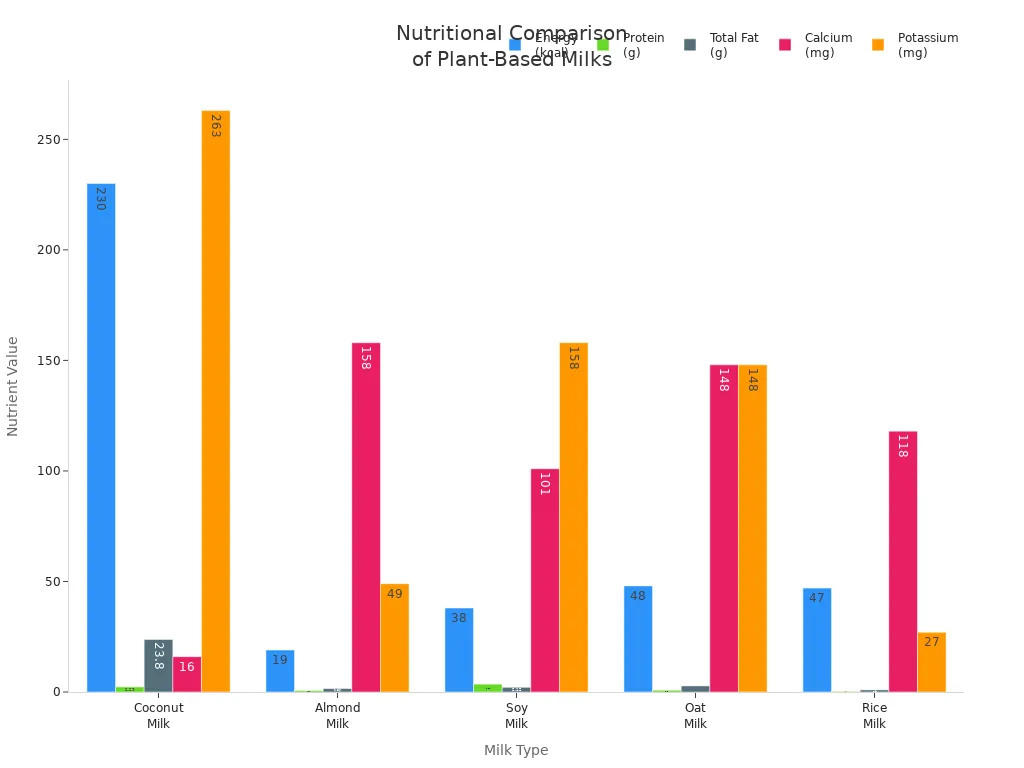
Note: Coconut milk does not have lactose. It is often given extra vitamins.
Coconut oil is made from dried coconut meat. People use coconut oil for cooking and baking. Many also use it for skin and hair care. Most coconut oil is used by food and drink companies. This is about 55% of the market. Virgin coconut oil is becoming more popular for skin and hair.
Market Segment | Primary Uses |
|---|---|
Food & Beverages | Cooking oil, baking, healthier alternative |
Personal Care & Cosmetics | Skincare, hair care, makeup remover, oil pulling |
Pharmaceuticals | Medicinal applications, health products |
Food and beverage companies use the most coconut oil.
Each year, more virgin coconut oil is used in cosmetics and personal care.
Desiccated coconut is coconut meat that is dried and grated. You can use it in baking, snacks, and sweets. There are strict rules for quality in international trade. Full-fat desiccated coconut must have at least 60% oil. The color should be white or creamy. The texture should be fine and grainy. It cannot have more than 3% moisture.
Quality Criteria | Description |
|---|---|
Oil (fat) content | ≥ 60% for full-fat, < 60% for low-fat |
Colour | Natural white to light creamy white |
Texture | Fine, granular |
Form | Extra fine, fine, medium, flakes, strips, chips, shreds, cubes, chunks |
Flavour | Sweet, mild, no off-flavours |
Odour | Mild, sweet, no off-odours |
Moisture | Max 3% |
Ash | Max 2.5% |
Total acidity | ≤ 0.3% as lauric acid |
Tip: Desiccated coconut is great for baking and making candy.
You can make many other things from coconuts. Coconut sugar and syrup are natural sweeteners. Coconut flour is gluten-free and good for baking. New products include coconut chips, coconut flour snacks, and coconut yogurt. These are popular with people who want healthy and dairy-free foods.
Coconut chips come in sweet and salty flavors.
Coconut flour snacks include crackers and protein bars.
Coconut yogurt and ice cream are dairy-free and have probiotics.
End Product | Market Demand and Applications |
|---|---|
Coconut Oil | Cooking, cosmetics, healthier alternative |
Hydrating beverage, rich in electrolytes | |
Coconut Milk and Cream | Non-dairy substitute, global cuisines |
Desiccated Coconut | Baking, confectionery |
Coconut Sugar and Syrup | Natural sweeteners |
Coconut Flour | Gluten-free baking |
Applications | Food & Beverage, Cosmetics, Pharmaceuticals, Nutraceuticals, Industrial sectors |
Coconut processing lets you make many products. This helps you meet market needs and grow your business.
You need to pick the right packaging to keep coconut products safe. Each packaging type has its own good points. Laminated cartons let you store coconut water for a long time without a fridge. Plastic bottles made from HDPE or PET are strong and light to carry. Glass bottles protect the product and are good for hot filling. Aseptic packaging keeps coconut milk and water clean and safe at room temperature.
Packaging Material | Advantages |
|---|---|
Laminated Carton | Aseptic packaging lets you keep products fresh for a long time without a fridge. It keeps quality high. |
Plastic Bottles (HDPE) | These bottles are tough and do not break easily. They can have special layers to keep products fresh longer. |
Plastic Bottles (PET) | These bottles are light and cheap. They can be cleaned for safe filling, but let in more air than glass. |
Glass Bottles | Glass is good for hot or clean filling. It does not scratch easily and can have extra protection. |
This packaging keeps products safe at room temperature. It stops germs from getting in and keeps things clean. |
Tip: Choose packaging that fits your product and what your buyers want. Strong packaging helps stop damage when shipping.
You have to follow strict rules when labeling coconut products. Labels help people know what they are buying and keep your products legal in many places. You must show the product name, net weight, and nutrition facts. Every package needs a batch number and where it was made. You also need to put the expiration date and allergen details.
You must label coconut water, juice, or concentrate so it is clear.
Bulk packaging needs:
Product name
Lot number
Best-before date
Maker or seller details
Storage and shipping info
Retail packaging must follow EU food rules.
Requirement | Description |
|---|---|
Product Name | The label must say what the product is. |
Net Weight | Show how much the product weighs. |
Nutritional Data | Give information about what is in the product. |
Batch Number | Put a special code for each batch. |
Country of Origin | Say where the product was made. |
Expiration Date | Show when the product should be used by. |
Allergen Information | List any allergens in the product. |
Note: Clear labels help buyers trust your product and help you sell in other countries.
You need good ways to get coconut products to customers everywhere. Supermarkets and hypermarkets sell the most coconut products. These stores have many choices and put products where people can see them. Online shopping is growing fast because it is easy and brings products to your door. Convenience stores help you reach city people who want to buy things quickly.
Distribution Channel | Key Features |
|---|---|
Supermarkets/Hypermarkets | These stores sell the most coconut products. They are easy for many people to visit. They have lots of choices and put products in good spots. They also have a strong supply chain. |
Online Retail | Online stores are growing fast. They are easy to use, give discounts, and deliver to your home. |
Convenience Stores | These stores are quick and easy for city shoppers. They help people get what they need fast. |
Supermarkets are the top place for coconut product sales.
Online stores make it easy to buy and get fast delivery.
Convenience stores help busy people in cities.
Tip: Use different ways to sell so you can reach more customers and grow your business.
You can make a good coconut processing plant if you follow easy steps. First, plan well and pick a smart place for your plant. Next, choose good equipment and use strong quality control. Try making different coconut products and pick the right packaging for each one.
Tip: Always remember your goals. Learn about new things in coconut processing. Take action and start your plant. The coconut market has many chances for you.
A small coconut processing plant needs at least 2,000 square feet. This space is enough for machines and storing coconuts. It also lets you move products around safely. If your plant is bigger, you will need more space.
Store coconut products in a cool and dry place. Use airtight packaging to keep out moisture and germs. Always check the temperature and humidity in storage. This helps keep your coconut products safe and fresh.
You should get certifications like HACCP, ISO 22000, and Organic. These certificates show your products are safe and good quality. Many countries want these certificates before you can sell there.
Yes, you can make both in one plant. You need different machines for each product. Many plants use multifunctional equipment for this. This lets you make coconut water, oil, and more in the same place.


